Saturday, May 7, 2016

The Branches of Semantics "Collocation"

COLLOCATIONS

Collocation is two or more words that often go together. These combinations just sound "right" to native English speakers, who use them all the time. On the other hand, other combinations may be unnatural and just sound "wrong". collocation is a familiar grouping of words, especially words that habitually appear together and thereby convey meaning by association.

Look at these examples :

NATURAL ENGLISH
UNNATURAL ENGLISH
the fast train
the quick train
fast food
quick food
a quick meal
a fast meal
a quick shower
a fast shower

The benefit of learn collocation :

a) Our language will be more natural and more easily understood.
b) We will have alternative and richer ways of expressing yourself.
c) It is easier for our brains to remember and use language in chunks or blocks rather than as single words.

How to learn collocations :

1) Be aware of collocations, and try to recognize them when you see or hear them.
2) Treat collocations as single blocks of language. Think of them as individual blocks or chunks, and learn strongly support, not strongly + support.
3) When you learn a new word, write down other words that collocate with it (remember rightly, remember distinctlyremember vaguelyremember vividly).
4) Read as much as possible. Reading is an excellent way to learn vocabulary and collocations in context and naturally.
5) Revise what you learn regularly. Practise using new collocations in context as soon as possible after learning them.
6) Learn collocations in groups that work for you. You could learn them by topic (time, number, weather, money, family) or by a particular word (take actiontake a chancetake an exam).
7) You can find information on collocations in any good learner's dictionary. And you can also find specialized dictionaries of collocations.
  
There are several different types of collocation made from combinations of verb, noun, adjective etc. Some of the most common types are :

a) Adverb + Adjective : completely satisfied (NOT downright satisfied)
b) Adjective + Noun : excruciating pain (NOT excruciating joy)
c) Noun + Noun : a surge of anger (NOT a rush of anger)
d) Noun + Verb : lions roar (NOT lions shout)
e) Verb + Noun : commit suicide (NOT undertake suicide)
f) Verb + Expression With Preposition : burst into tears (NOT blow up in tears)
g) Verb + Adverb : wave frantically (NOT wave feverishly)


References :
http://semantic-introduction.weebly.com/collocations-fixed-expressions-and-idioms.html
http://grammar.about.com/od/c/g/collocationterm.htm
https://www.youtube.com/watch?v=nh8r9SDmHn4

The Branches of Semantics "Antonym, Synonym and Hyponym"

ANTONYMY, SYNONYMY, AND HYPONYMY

A.  Antonymy

Antonymy is the state or phenomenon in which the words have the sense relation which involve the opposite of meaning. The concrete form of antonymy is called “antonym” (opposite). Antonyms are words which have opposite meanings. The words hot and cold are antonyms. So are up and down, and short and tall. A word can have more than one antonym, depending on which meaning you use for the word.

For example :
- short could have the antonym tall if you are referring to a person's height.
- short could have the antonym long if you are referring to the length of something.

In many languages, including English, you can sometimes make antonyms by adding a prefix :
- real and unreal are antonyms
- flexible and inflexible are antonyms

The word pairs of antonym can be divided into several types, there are :

a)    Implicitly Gradable Pairs (Graded Antonym)
Refers to the words related to the object they modify, opposites at either end of the
spectrum.
Examples :
     small    ><  big
     good    ><  bad
     slow     ><  fast
     old       ><  young
b)  Complementary Pairs (Complemetarity)
Refers to the existence of pairs that the denial of one, implies the assertion of the other
(absolute opposites).
Examples :
     male    ><  female
     alive    ><  dead
     awake  ><  asleep
     mortal  ><  immortal
c)  Relational Pairs (Converseness)
Opposites where one word describes a relationship between two objects, and the other word describes the same relationship when the two objects are reversed.
Examples :
     buy      ><  sale
     give     ><  take
     teach   ><  learn
     doctor ><  patient

In English, there are a number of ways to form antonyms. You can add the prefix (un-) :
Examples :   likely      ><     unlikely
                   able        ><     unable

or you can add (non-) :
Examples :   entity     ><     nonentity
                   descipe  ><     unable

or you can add (in-) :
Examples :   tolerant  ><     intolerant
                   visible    ><     invisible


B.   Synonymy
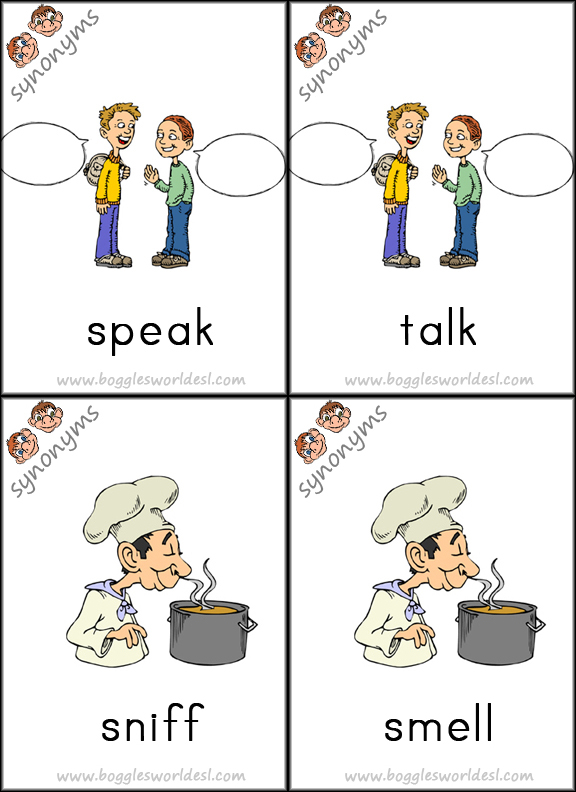
Synonymy is the state or phenomenon in which the words that sound different (different in pronounciation) but have the same or identical meaning as another word or phrase. Synonyms can be nouns, verbs, adverbs or adjectives, as long as both are the same part of speech.

For example :
- chair and seat            (nouns)
- go and leave              (verbs)
- quickly and rapidly    (adverbs)
- long and extended     (adjectives)

Here are more synonyms :
-       small                         =   little
-       big                            =   large
-       mother and father      =   parents
-       sick                           =   ill


A word can have more than one synonym depending on which meaning you use for the word.
For example :
- expired could have the synonym no longer fresh, if you mean milk that's past its sale date.
- expired could have the synonym dead, if you mean no longer alive.


C.  Hyponymy

Hyponymy is the state or phenomenon that shows the relationship between more general term (lexical representation) and the more specific instances of it. In linguistics, a hyponym is a specific term used to designate a member of a broader class. For instance, daisy and rose are hyponyms of flower. Also called a subtype or a subordinate term. Words that are hyponyms of the same broader term (that is, a hypernym) are called co-hyponyms.

Example :
The lexical representation of :
red, yellow, green, blue, purple, black, is (color)

Thus, we can say that : “red” is a hyponym of “color”

The relationship between the general term and the specific instances is often be described using a hierarchical diagram, called “taxonomy”.


References :
http://www.slideshare.net/Andriyanieka12/13-semantics-synonym-antonym-homonym-hyponym-polyseme-idioms-18509523
http://englishsemantics4eslstudents.blogspot.co.id/2011/02/synonym-antonym-and-hyponym.html
https://www.youtube.com/watch?v=cPddLCf73QA&list=PLp44Ee2YHzxzxXO1wx-M4v06oLZLFWt0d
https://www.youtube.com/watch?v=7cCqu5hArDQ&spfreload=10

Friday, May 6, 2016

Word Formation Processes "Affixation"

Affixation
           Affixation is the adding of bound morphemes to the base to base to form a word. The adding of the bound morphemes initially to a base is called prefixes, the adding of the bound morphemes inside the base is called infixes, while the combination of prefix and suffix which constructs a unity is named confixes and the adding of the bound morphemes to the end of base is called suffixes.
           Affixation is the morphological process of attaching or adding an affix to the root, stem or base form. According Bauer (1983: 20) root, stem and base are all terms used in the literature to designate that part of a word that remains when all affixes have been removed. A root is a form which is not further analyzable, either in terms of derivation or inflection morphology. A stem is of concern only when dealing with inflectional morphology. And base is any form to which affixes of any kind can be added.
           Affixes can be defined as a closed class of grammatical elements within the word. They are bound morphemes and cannot occur on their own. A fair number of affixes change the word class of the root to which they are affixed. Formally, the following categories can be distinguished: prefixes, suffixes, confixes and infixes.
           There are two types of affixation is derivational and inflectional. Derivational suffixes, however, are used to change both meaning and use of existing lexical items.  In other words, when a derivational morpheme is added to a word, it “results in either a different part of speech or the same part of speech with a different lexical meaning” (Celce-Murcia and Larsen-Freeman 1999: 31).  For example, ment, as in the word achievement (achieve + ment), makes a noun from a verb, changing both the part of speech and the meaning.
1.         Prefixes


       Prefix may be classified into two categories depending on whether they change or maintain the word-class categories of the derived words. The word prefix is composed of a root and a prefix. A prefix is a meaningful unit of one or more syllables added to the beginning of a root to form a new word.

The following are some prefixes that are commonly used in English.
1.  Negative Prefixes
a) in-     
     e.g. : in-       +       operable      = inoperable
     b)  dis-
           e.g. :  dis-      +       order            = disorder
     c) un-
           e.g. :  un-      +       rest              = unrest   
     d) non-
     e.g. :  non-    +       stop            = nonstop 

e)     a-
           e.g. :  a-         +       sleep           = asleep

                         
2.  Pejorative Prefixes
         This prefix is attached to give the meaning of “wrongly”.
a)     mis-
                 e.g. :   mis-     +       lead             = mislead
          mis-     +       fortune       = misfortune
b)    mal-
                 e.g. :   mal-    +       nutrition     = malnutrition
          mal-    +       adjusted      = maladjusted

3.  Prefix of Degree or Size
a)     over-
                 e.g. :   over-   +       charge         = overcharge
          over-   +       growth        = overgrowth
b)    out-       
                 e.g. :   out-     +       grow            = outgrow
                             out-     +       number      = outnumber

4.  Prefix of Position in Time or Space
a)     under-
                 e.g. :   under- +       ground        = underground
                             under- +       world           = underworld
b)    fore-
                 e.g. :   fore-    +       tell                = foretell
                             fore-    +       warn            = forewarn
c)     mid-
                 e.g. :   mid-    +       night             = midnight
    mid-    +       semester      = mid-semester
d)    inter-
                 e.g. :   inter-   +       dependence = interdependence
                             inter-   +       mix                = intermix

5.  Prefix of number
a)     bi-
                 e.g. :   bi-       +       lingual           = bilingual
    bi-       +       labial             = bilabial
b)    multi-
                 e.g. :   multi-  +       media           = multimedia
    multi-  +       talented       = multitalented

2.         Suffixes


Suffix is a morphological process whereby a bound morpheme is process whereby a bound morpheme is attached to the end of a stem. There are two kinds of suffixes; they are inflectional and derivational suffixes. Inflectional suffixes do not change the word class of the word it is attached to. In contrast, derivational suffixes usually but not always change the word class of the word it is attached to.

a.       Inflection Suffixes
-   added to nouns to form plurals and possessives
e.g.  : book      =>       books
               Boy        =>       boys
               John      =>       John’s
-       added to verbs to indicate tense
e.g.  : change  =>       changed
           Kick      =>       kicked
           Drink    =>       drinking
-       added to adjective to indicate tense
e.g.  : fast        =>       faster        =>     fastest
          Bright    =>       brighter   =>     brightest

b.   Derivational Suffixes
Derivational suffixes usually change the word class from one part of
speech to another one.
-         From a verb to a noun
e.g.  : achieve           =>     achievement
          Survive          =>     survival
          Press              =>     pressure
          Bank              =>     banker
-         From a noun to a verb
e.g.  : victim             =>     victimize
          Class               =>     classify
          Beauty            =>     beautify
-         From a noun to an adjective
e.g.  : care                 =>     careful
           Legend           =>     legendary      
           Week              =>     weekly
           President       =>     presidential
                                        Humor            =>     humorous
-         From an adjective to a noun
e.g.  : eager              =>     eagerness
              Ready             =>     readiness
   Intelligent     =>     intelligence
-         From a verb to an adjective
e.g.  : communicate  =>     communicative
              Differ                =>     different
              Read                 =>     readable
              Please               =>     pleasant
-         From an adjective to a verb
e.g.  : black                =>     blacken
              Sharp               =>     sharpen

Based on the class of the words, English suffixes can be divided into four types, they are:
1.       English suffixes of noun
a.        Denoting agent or doer
    -er
       e.g.  : Bake   +    -er       = baker
    -ster
       e.g.  : Gang   +    -ster    = gangster


b.       Denoting state, action, condition, being
    - dom
       e.g.  : king     +    -dom   = kingdom
                   -hood (-head)
        e.g.  : Child   +    -hood  = childhood
    -lock (-ledge)
        e.g.  : Know  +    -ledge  = knowledge

c.   Forming diminutives (smallness)
    -let    
        e.g.  : stream +    -let      = streamlet
    -ling   
        e.g.  : duck    +    -ling    = duckling

2.            English suffixes of adjective
a.        –ed means having
                       e.g.  : gift       =>   gifted                
b.       –en means made of
                 e.g.  : wood  =>   wooden            

3.       English suffixes of verbs
a.        –en means causative, forming transitive verbs
                 e.g.  : week   =>   weaken
b.       –se means to make
                 e.g.  : clean   =>   cleanse

4.       English suffixes of adverbs
a.        –ly means like
    e.g.  : bold    =>   boldly
b.       –long
   e.g.  : head    =>   headlong  

3.        Infixes
         An infix is an affix inserted inside a stem (an existing word). It contrasts with affix, a rare term for an affix attached to the outside of a stem, such as a prefix or suffix. An infix is a word element (a type of affix) that can be inserted within the base form of a word (rather than at its beginning or end) to create a new word or intensify meaning. Also called an integrated adjective.

4.        Confixes
A confix is an affix which consists of at least a prefix and a suffix that is placed before and after a root word. It needs to be considered that the prefix and suffix must be appeared together. Take the example in Indonesian language, the word “berdatangan” and “berhalangan”. For instance, the word “berdatangan” is derived from “datang” and confix “ber-an” which is attached together. The word “berdatangan” is a unity because there is no word “datangan” in Indonesia. While, the word berhalangan is not a confix. It is firstly formed from word “halang” and suffix “an” and then prefix “ber” is added. The word “halangan” can be found in Indonesian language. That is why the word “berhalangan” is not a confix. The word "confix" is itself made up of the suffix -fix (meaning "attach", in this case), and the prefix con- (meaning "with"), both of which are derived from Latin roots.

Examples of confixes in Indonesian :
1.  One prefix and one suffix on a non-reduplicative word: kebaikan (ke+baik+an) - "goodness"
2.  One prefix and one suffix on a compound word: dijungkirbalikkan (di+jungkir balik+kan) - "being overthrown", jungkir balik lit. "upside down"

References :
http://uhn.ac.id/uploads/fbs/episteme4
http://grammar.about.com/od/il/g/infixterm.htm
http://www.ruf.rice.edu/~kemmer/Words/wordtypes.html